
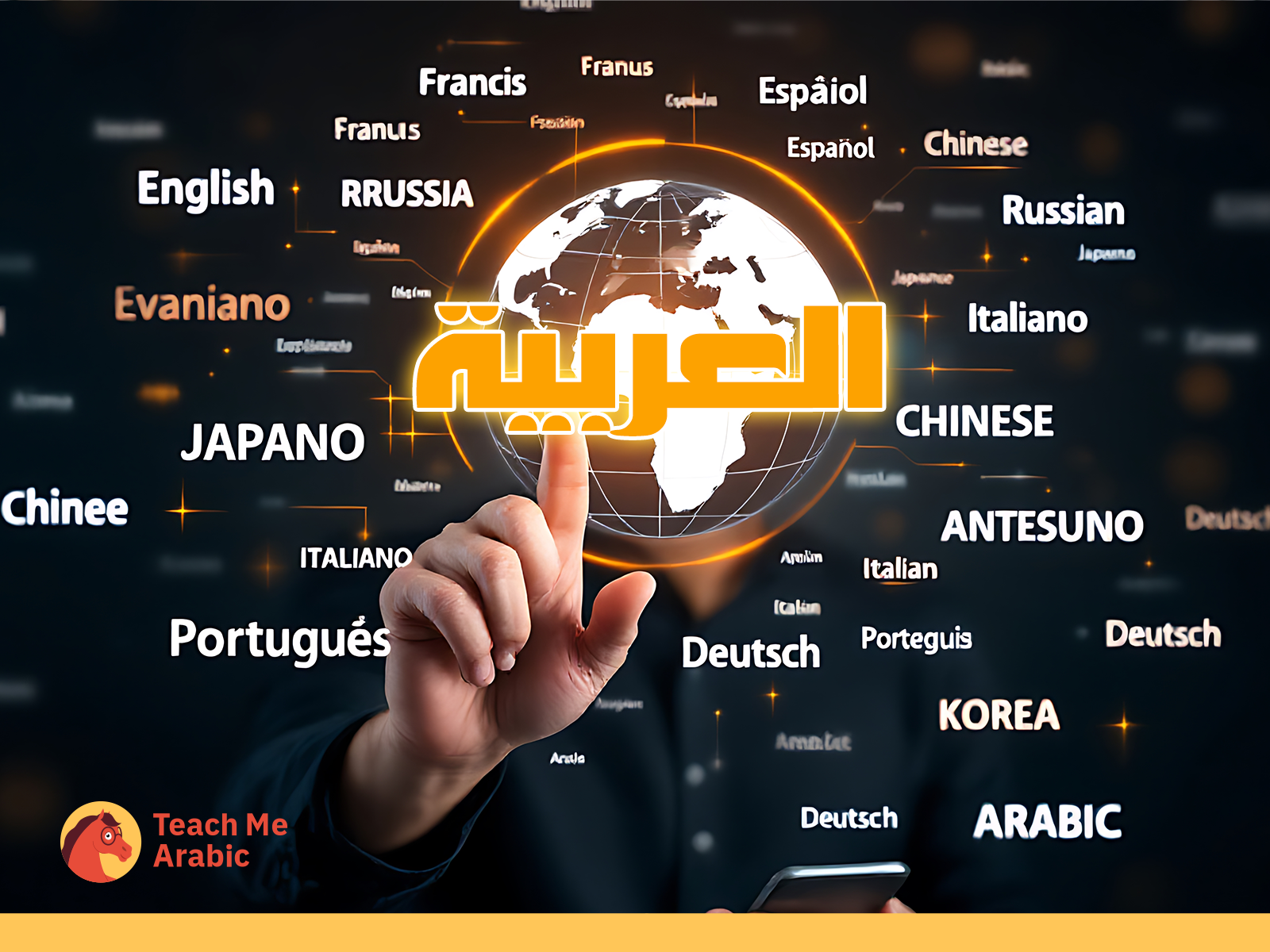
The Magic of Arabic: Why It Is Considered One of the Most Beautiful Languages in the World
Introduction
Is there such a thing as a beautiful language and an ugly one?
Certainly not. Yet every language possesses unique qualities across multiple dimensions that give it its own aesthetic character.
To begin with, what is language?
It is a phonetic system and a set of written symbols that carry mental signals, which the brain translates into meaning, transforming them into understanding and communication.
Here we arrive at the heart of the matter:
Did the Arabic language settle for being merely a phonetic system that serves the purpose of conveying meaning?
It did not. Arabic went far beyond that. It carried a long history and a vast cultural heritage. It became a vessel for knowledge and the voice of a human renaissance whose impact extended for centuries, leaving a lasting mark on the course of human civilization. Along this historical journey, its lexical wealth expanded, its vocabulary diversified, and its expressive capacity grew deeper and more precise.
From this richness, the story begins.
In this article, we take you on a linguistic and aesthetic journey—one that brings us closer to the secrets of Arabic, reveals aspects of its greatness, and explains why it has settled in the hearts of many as one of the most beautiful languages in the world.
Phonetic Musicality in Arabic
Arabic possesses a uniquely structured phonetic system, in which letters are articulated from precise points, starting from the deepest part of the throat and ending at the lips. This creates a wide range of sounds—between strength and softness, whispering and voicing—combined in a balance rarely found within a single language.
This harmony makes Arabic naturally suited for chanting and recitation, pleasant to the ear, and easy to internalize—even for those unfamiliar with the language.
When a non-native learner pronounces an Arabic word, they often feel the tongue moving with awareness and the sound emerging effortlessly from its natural articulation point. This is why Arabic is strongly associated with rhythm and melody. Many learners are drawn to it by listening first, with meaning following to complete the experience.
This beauty is not limited to individual sounds. It appears in sentence structure and in the harmony of sounds within context. Arabic expressions often feel as though they were crafted to be spoken rather than merely read. From here comes Arabic’s ability to influence, delight, and endure—heard with pleasure, memorized with ease, and recalled by melody before meaning.
Lexical Richness and Precision of Expression
Arabic possesses vast lexical wealth that enables it to approach a single meaning from multiple angles without sacrificing clarity or precision. Words are not chosen randomly; they are selected according to context and subtle semantic nuance.
This diversity allows learners to express meaning gradually—moving from the general to the specific, from the direct to the suggestive—depending on intention.
Sadness, for example, is not expressed by a single word, nor is joy limited to one linguistic state. Each emotion has vocabulary that captures it with depth and accuracy.
This precision becomes even clearer through Arabic’s derivational system. Words stem from stable roots, generating interconnected forms that share meaning. This structure allows learners to understand new vocabulary logically rather than memorizing words in isolation.
Thus, lexical richness is not a burden—it is a bridge to understanding, a space for choice, and a tool for faithful expression. It grants Arabic its depth and gives speakers the ability to say exactly what they mean, how they mean it.

Form and Meaning: Why Translation Weakens the Magic of Arabic Poetry
Imagine translating a line of eloquent Arabic poetry into another language. Immediately, much of its magic fades. The delicate relationship between poetic form and layered meaning is lost. Words no longer interact in the same way, and the internal rhythm weakens.
Translation may convey general meaning, but it cannot fully transmit emotional depth, rhetorical complexity, or musical structure. Arabic poetry is more than words—it is an integrated system where sound, meaning, and structure work together to create an experience that transcends literal translation.
Arabic and Civilizational History
For centuries, Arabic held a distinguished position as the language of science, philosophy, and literature. During the Abbasid era and beyond, scholars relied on Arabic to transmit knowledge and compose intellectual and literary works.
This elevated Arabic to the status of a global language of its time, circulating among diverse cultures. Its influence extended to other languages, which adopted Arabic terminology in science, medicine, philosophy, and literature—making Arabic a bridge between civilizations.
Arabic became a vessel of identity, heritage, and intellectual creativity, uniting phonetic beauty with semantic depth to create a complete cultural and cognitive experience.
Conclusion: Arabic as a Living Experience
Arabic is a comprehensive sensory and intellectual experience where sound meets meaning, language meets culture, and history meets imagination. Its beauty lies in its phonetic rhythm, lexical richness, and enduring cultural impact.
Learning Arabic as a non-native speaker goes beyond grammar and structure. It becomes a journey into expressive elegance, rhetorical artistry, and the magic of words. Each step reveals new dimensions, and every word spoken adds depth and enjoyment.
The magic of Arabic continues to connect past and present, offering learners a sense of belonging to a civilization rich in meaning and expression—affirming that Arabic is not merely a language, but a living spirit that speaks to both mind and heart.
Edited by: Teach Me Arabic Team