
Struggling with Arabic Pronunciation? pronouncing Arabic letters and words accurately is fundamental to mastering the language. For non-native learners, especially beginners, this can be one of the most challenging aspects.
In this guide from “Teach Me Arabic” app, we delve into common challenges faced when trying to improve Arabic pronunciation and offer practical steps, complete with examples and exercises, to help you progress confidently in your language learning journey.
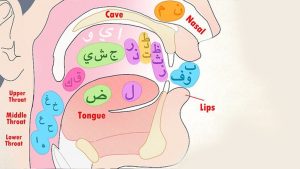
Why Focus on Improving Arabic Pronunciation?
Correct pronunciation enhances communication skills, deepens understanding of grammatical structures, and boosts learners’ confidence. Despite the diverse sounds and articulation points in Arabic, beginners can overcome these challenges with effective strategies and consistent practice.
The Importance of Pronunciation in Arabic for Beginners
Studies indicate that improving pronunciation at the early stages of learning Arabic directly contributes to better comprehension and listening skills.
Therefore, regular pronunciation practice is considered one of the most essential components of educational programs designed for Arabic language beginners.
Key Challenges in Learning Arabic Pronunciation for Beginners
- Differentiating Similar Sounds: Distinguishing between letters like (ض) and (ظ), or (ق) and (ك), as in “قلب” (heart) and “كلب” (dog).
- Pronouncing Guttural Letters: Sounds like (ع) and (غ) can be particularly tricky.
- Understanding Short and Long Vowels: Grasping the use of diacritics and vowel lengths, especially for learners whose native languages don’t use similar systems.
- Accurate Articulation: Mispronunciation can change meanings entirely, such as “صاحب” (friend) vs. “ساحب” (withdrawer).
- Lack of Exposure: Limited access to native pronunciation models and insufficient practice can hinder progress.
5 Practical Steps to Improve Arabic Pronunciation
- Listen to Standard Arabic Audio: Engage with news broadcasts, podcasts, or audiobooks in Modern Standard Arabic.
- Mimic Native Speakers: Observe mouth movements and practice speaking in front of a mirror to replicate sounds accurately.
- Record and Compare: Record your speech and compare it to native pronunciations to identify areas for improvement.
- Utilize Educational Apps: Employ apps offering interactive pronunciation exercises and feedback.
- Embrace Mistakes: Understand that errors are part of the learning process and use them as opportunities to improve.

#Arabic pronunciation practice
Recommended Apps to Enhance Arabic Pronunciation
“Teach Me Arabic” app – A Comprehensive Learning Experience
Designed for non-native speakers, this app combines self-paced lessons with live sessions from native Arabic instructors. Key features include:
Extensive Audio and Video Library: Access to a wide range of materials to practice listening and pronunciation.
Interactive Exercises: Engaging activities like multiple-choice questions and sentence rearrangement to reinforce learning.
Live Tutoring Sessions: Opportunities to practice speaking and receive immediate feedback.
Progress Tracking: Regular assessments to monitor improvement and identify areas needing attention.
Thanks to these features, “Teach Me Arabic” app is an ideal choice for beginners seeking to improve their Arabic pronunciation in a structured and interactive way.
Lathgha
Specializing in speech therapy, Lathgha offers targeted exercises to address pronunciation challenges, with options to consult language specialists and participate in group training sessions.
Arabic Speaker
This app aids users with speech difficulties by providing predictive text features, categorized common phrases, and options for both automated and personal voice recordings.
Amal Arabic Language App
Focusing on children’s learning, Amal employs AI to correct pronunciation errors and offers an engaging educational experience through listening, reading, speaking, and writing exercises.
LangAI
Utilizing artificial intelligence, LangAI provides instant feedback on pronunciation, allowing users to converse with a chatbot and receive explanations for any mistakes in real-time.
By using these tools and similar ones, beginners can effectively and systematically improve their Arabic pronunciation.
Explore More:
Next Steps Towards Fluent Arabic Pronunciation
Improving Arabic pronunciation is a journey that requires patience and dedication. By integrating tools like the “Teach Me Arabic” app into your daily routine, engaging in regular listening and speaking practice, and embracing the learning process, you can make significant strides in your language proficiency.
Remember, consistency is key. Allocate time each day to practice, remain open to feedback, and celebrate your progress along the way.
Start today—download “Teach Me Arabic” app and be confident that every step you take brings you closer to your goal of speaking Arabic fluently and confidently. Keep repeating, keep trying, and keep learning!
Edited by: Teach Me Arabic Team©
Sources:
- Al Jazeera Media Institute
- MIT Technology Review – Majarra