
How Artificial Intelligence Is Transforming the Future of Arabic Language Education
Introduction
In recent years, education has undergone profound transformation driven by artificial intelligence (AI), which has redefined how learning happens. The learner is no longer a passive recipient of knowledge but an active participant in a personalized learning journey, where intelligent tools adapt to individual pace and ability.
As Arabic expands rapidly in the digital world, AI’s role goes beyond helping learners master grammar and vocabulary it now serves as a guardian of linguistic authenticity and a bridge that strengthens Arabic’s cultural and intellectual presence in the digital sphere. The goal is not only education, but also protecting the identity of the language and ensuring its continuity as a living entity in an era of accelerating innovation.
This article explores how AI is reshaping the future of Arabic education through its power to personalize learning, support teachers, address linguistic challenges, and promote inclusivity and accessibility, while envisioning opportunities to sustain Arabic as a vibrant and influential language in the digital world.
Artificial Intelligence and Personalized Learning
One of AI’s most significant contributions to education is its ability to personalize learning for every student. Through advanced data analytics, AI can track student performance, identify strengths and weaknesses, and design individualized learning plans that address specific needs. These systems also provide instant feedback, continuous assessment, and targeted content recommendations to enhance understanding.
Platforms like Duolingo, Khan Academy, and Allimni Al-Arabiya demonstrate how AI-powered adaptive learning gives students freedom to progress at their own pace while receiving guided support when necessary—making the learning experience both personal and realistic.
The Teacher’s Role in the Age of AI
Despite rapid technological progress, teachers remain the cornerstone of the educational process. AI is not designed to replace teachers but to empower them. With access to detailed data on student performance, teachers can design more effective lessons, identify learners who need extra support, and provide personalized guidance to improve outcomes.
This synergy between human expertise and machine intelligence—known as Human-in-the-Loop creates a dynamic educational model. Teachers and AI systems collaborate continuously to ensure content accuracy, adapt instruction to each student, and balance technological innovation with human insight.
Linguistic Challenges of Arabic and AI
Arabic presents unique challenges for AI due to its rich morphology, complex grammatical structures, and intricate system of derivation and root patterns.
Most large language models such as GPT, Mistral, and Gemini still struggle to fully grasp Arabic’s nuanced contexts. This can lead to grammatical inconsistencies or errors in diacritics that alter meaning.
Moreover, the limited availability of high-quality Arabic datasets hinders the generation of natural and fluent Arabic content. This underscores the urgent need for specialized AI tools designed to handle the linguistic and cultural depth of the Arabic language.
Practical Applications of AI in Arabic Education
AI can enrich Arabic learning in multiple ways:
- Personalized Learning: Designing individual learning paths tailored to each student’s pace and style to ensure steady and balanced progress.
- Automated Assessment: Grading assignments and tests instantly while providing detailed feedback that helps learners recognize and correct mistakes.
- Chatbots: Offering intelligent conversational assistants that simulate real-life interactions and allow learners to practice Arabic dialogue naturally.
- Intelligent Content: Generating educational materials—books, videos, and exercises—that align with each student’s learning preferences for deeper understanding.
- Performance Analytics: Tracking learning patterns and providing teachers with insights to refine teaching strategies and adapt them to diverse needs.
Enhancing Accessibility to Arabic Learning
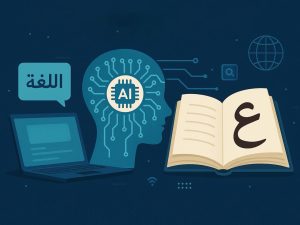
AI also promotes inclusivity by making Arabic more accessible to everyone. Text-to-speech tools help visually impaired learners, while instant translation and content dubbing break language barriers for non-native speakers.
These innovations make Arabic content more suitable for learners with different abilities and learning challenges, ensuring an inclusive digital learning environment that welcomes all.
Digital Opportunities for the Future of Arabic Education
Arabic is only at the beginning of its integration with AI, which opens vast opportunities to develop smarter, more accurate tools capable of understanding complex structures, analyzing compound sentences, and adapting to various dialects.
Achieving this vision requires strong research investment, academic collaboration, and contributions from Arabic institutions to enrich digital content. These efforts will help build AI platforms that rely on accurate, culturally rooted Arabic data preserving the language’s authenticity and heritage while driving innovation.
Conclusion
Artificial intelligence is not a threat to the Arabic language it is a golden opportunity to advance its teaching, global presence, and cultural preservation. The key to success lies in achieving a smart balance between human creativity and technological power, ensuring that innovation serves the language rather than replaces it.
The future of Arabic is in our hands. It is our shared responsibility to shape its evolution in the digital age so that Arabic remains a living language, rich in culture and knowledge, resonating across generations and technologies.
Edited by: (Teach Me Arabic)
References
The Future of the Arabic Language in the Age of Artificial Intelligence and Large Language Models
🔗 https://fomlar.org/%D9%85%D8%B3%D8%AA%D9%82%D8%A8%D9%84-%D8%A7%D9%84%D9%84%D8%BA%D8%A9-%D8%A7%D9%84%D8%B9%D8%B1%D8%A8%D9%8A%D8%A9-%D9%81%D9%8A-%D8%B8%D9%84-%D8%A7%D9%84%D8%B0%D9%83%D8%A7%D8%A1-%D8%A7%D9%84%D8%A7%D8%B5/
AI Is Transforming the Future of Education: Smart Tools Are Reshaping the Classroom
🔗 https://acforai.com/news/%D8%A7%D9%84%D8%B0%D9%83%D8%A7%D8%A1-%D8%A7%D9%84%D8%A7%D8%B5%D8%B7%D9%86%D8%A7%D8%B9%D9%8A-%D9%8A%D8%BA%D9%8A%D9%91%D8%B1-%D9%85%D8%B3%D8%AA%D9%82%D8%A8%D9%84-%D8%A7%D9%84%D8%AA%D8%B9%D9%84%D9%8A/
AI and the Arabic Language: An Opportunity to Strengthen Cultural Identity
🔗 https://mbzuai.ac.ae/ar/news/%D8%A7%D9%84%D8%B0%D9%83%D8%A7%D8%A1-%D8%A7%D9%84%D8%A7%D8%B5%D8%B7%D9%86%D8%A7%D8%B9%D9%8A-%D9%88%D8%A7%D9%84%D9%84%D8%BA%D8%A9-%D8%A7%D9%84%D8%B9%D8%B1%D8%A8%D9%8A%D8%A9/