
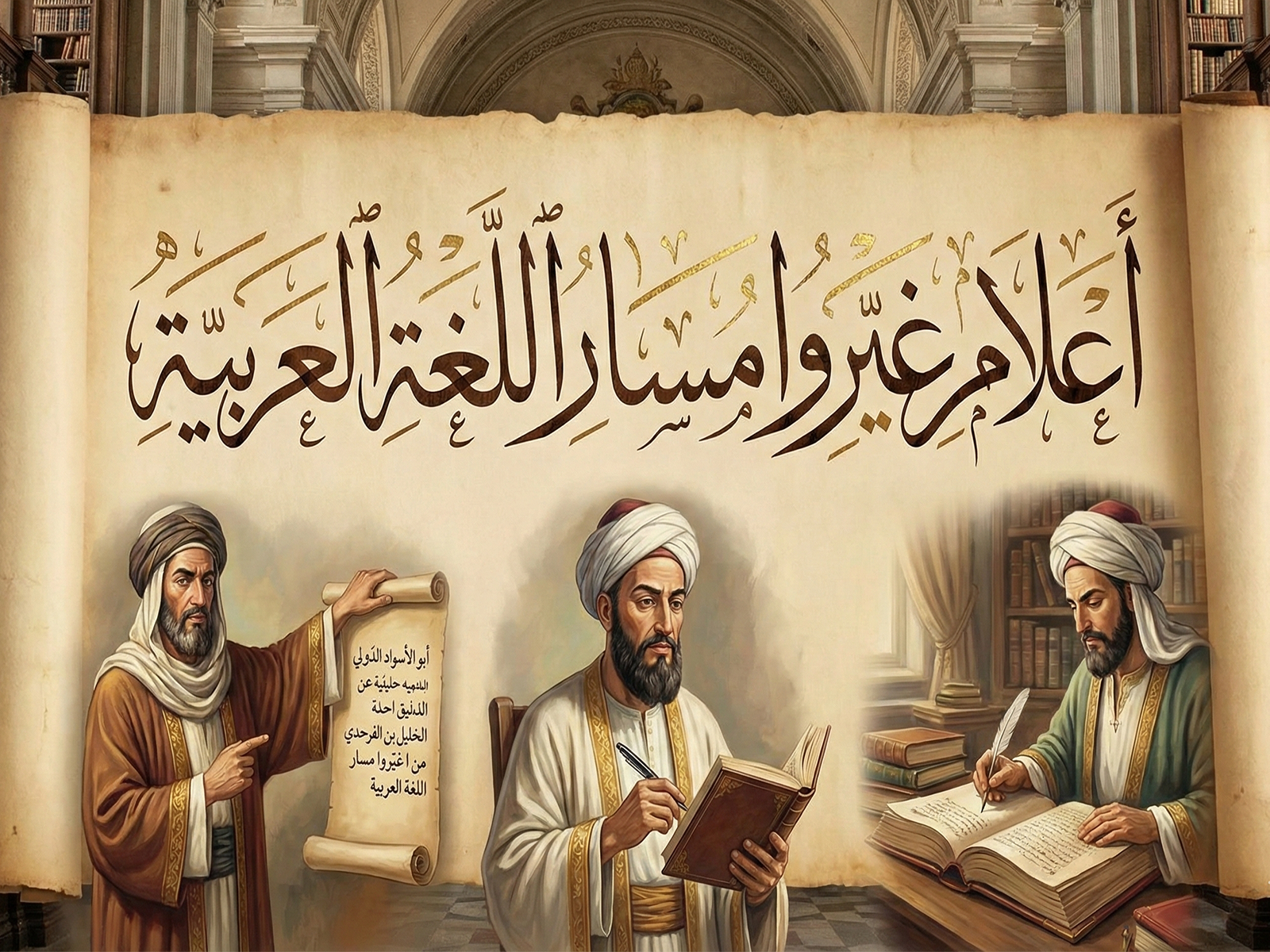
Figures Who Changed the Course of the Arabic Language
Introduction
The Arabic language is an integrated system of meanings and rules, carrying a rich cultural and intellectual heritage that has extended across centuries. Words in Arabic are not merely tools for communication, but instruments for shaping thought, expressing beauty, and conveying precise meanings, making the language far more than a collection of spoken symbols.
Throughout history, scholars of grammar, rhetoric, and literature contributed to establishing linguistic rules, organizing vocabulary, and documenting Arabic sciences, transforming the language into a systematic tool for analysis and understanding, while ensuring the continuity of its cultural legacy for future generations.
In this article, we explore the most influential figures who shaped the course of the Arabic language, highlighting their contributions and their lasting impact on the development of this enduring language.

Pioneers of Arabic Grammar and the Foundations of Syntax
In its early stages, Arabic faced an increasing need for grammatical regulation due to the spread of linguistic errors. This led to the emergence of pioneers who laid the foundations of syntax and diacritics, establishing strict rules that scholars and readers could rely on when studying the language and analyzing texts. Among them were:
Abu al-Aswad al-Du’ali (d. 69 AH / 688 CE)
Abu al-Aswad al-Du’ali established the foundations of Arabic syntax and introduced diacritical marks to regulate word pronunciation, which clarified meaning and facilitated accurate reading and comprehension of texts—particularly the Qur’an and Arabic poetry, both of which require precision in pronunciation and rhythm.
These innovations helped unify textual readings, reduce ambiguity in meaning, and laid the groundwork for grammatical principles adopted by later scholars. His role extended beyond linguistic organization to the methodological establishment of a precise understanding of the relationship between words and their positions within sentences, making him a cornerstone in the later analysis and understanding of Arabic.
Al-Khalil ibn Ahmad al-Farahidi (100–175 AH / 718–791 CE)
The founder of the Basran school and teacher of Sibawayh, Al-Kisa’i, and Al-Asma‘i—some of the greatest scholars of Arabic—Al-Khalil authored the first comprehensive Arabic dictionary, Al-‘Ayn, in which he collected vocabulary and arranged letters according to their phonetic articulation, following a precise methodological system that considered derivation and meaning.
He also founded the science of prosody (‘Ilm al-‘Arud), organizing the rhythm of Arabic poetry and defining its metrical patterns, thus preserving its aesthetic structure. His contributions provided scholars with precise tools for understanding poetic and prose texts and established a solid linguistic framework that bridged classical heritage with modern linguistic studies, inspiring generations of research in grammar, lexicography, and prosody.
Sibawayh (d. 180 AH / 796 CE)
Sibawayh compiled the rules of Arabic grammar in his renowned work Al-Kitab, presenting a comprehensive system for studying the Arabic language. He examined the intricate relationships between words and sentences and how they interact to convey meaning, using examples that linked grammar with rhetoric and eloquence, revealing the precision and beauty of Arabic.
Al-Kitab provided a methodological framework that facilitated textual analysis and syntactic understanding, positioning Arabic as a language suitable for intellectual and literary analysis. It also unified grammatical principles and explained variations in Arab speech patterns, offering scholars a robust scientific foundation for linguistic research. To this day, Al-Kitab remains a central reference in Arabic grammatical studies.
Lexicographers and Linguists
As Arabic vocabulary expanded and its uses diversified, the need arose to compile and document words in systematic dictionaries. Lexicographers played a pivotal role in preserving linguistic wealth and providing precise tools for understanding vocabulary and derivation, enabling later generations to study Arabic texts, poetry, and prose in depth. Among them were:
Abu Nasr al-Jawhari (d. 393 AH / 1002 CE)
Al-Jawhari compiled Arabic vocabulary in his dictionary Al-Sihah fi al-Lughah, documenting meanings and derivations. His work became a foundational reference for later dictionaries and helped preserve the richness of Arabic for future generations.
Ibn Manzur (d. 711 AH / 1311 CE)
Ibn Manzur authored Lisan al-‘Arab, compiling word meanings and structures based on earlier dictionaries. The work contains approximately eighty thousand lexical entries supported by evidence from the Qur’an, Hadith, and Arabic poetry, making it an essential reference for studying and preserving Arabic vocabulary.
Ibn Jinni (d. 392 AH / 1002 CE)
A distinguished linguist and rhetorician, Ibn Jinni focused on eloquence, morphology, and the characteristics of words in Arabic poetry and prose, emphasizing the relationship between sound and meaning. His notable work Al-Khasa’isprovided precise tools for stylistic and rhetorical analysis, uncovering underlying rules governing word and sentence structure.
Unlike traditional lexicographers, Ibn Jinni emphasized scientific linguistic analysis, treating Arabic as a systematic subject of research. His approach enabled scholars to study poetic and prose texts with greater accuracy and to analyze rhetorical and stylistic techniques methodically.
Scholars of Rhetoric and Literary Criticism
The contributions of Arabic scholars extended beyond grammar and lexicography to rhetoric and criticism, disciplines that enhance precision and beauty in expression. These scholars established frameworks for stylistic analysis and rhetorical understanding, transforming rhetoric into a structured science applicable to literary and poetic texts.
Ibn al-Mu‘tazz (d. 296 AH / 908 CE)
Ibn al-Mu‘tazz is regarded as the founder of ‘Ilm al-Badi‘ (the science of rhetorical embellishment), one of the three core branches of Arabic rhetoric alongside Ma‘ani and Bayan. This discipline focuses on beautifying speech through lexical devices such as alliteration and rhyme, as well as semantic devices like contrast and wordplay.
In his book Al-Badi‘, Ibn al-Mu‘tazz classified rhetorical devices within a coherent scientific framework, demonstrating that they were rooted in earlier poetic traditions. Later scholars—including Qudamah ibn Ja‘far, Abu Hilal al-‘Askari, and Ibn Rashiq al-Qayrawani—further developed this field, strengthening the foundations of Arabic rhetorical studies.
Abd al-Qahir al-Jurjani (d. 471 AH / 1079 CE)
One of the most prominent figures in Arabic rhetoric, Al-Jurjani presented in Dala’il al-I‘jaz and Asrar al-Balaghah a detailed analysis of how stylistic structure influences meaning in literary and poetic texts. He established a clear methodology for understanding rhetoric and linguistic eloquence, providing precise tools for analyzing textual aesthetics and persuasive power. His works remain foundational references in Arabic rhetorical studies.
The Impact of These Figures on the Arabic Language
Over time, the collective efforts of these scholars built a comprehensive linguistic system that integrates precise grammar, organized lexicography, and systematic rhetoric. This framework enabled scholars to analyze Arabic texts—both poetic and prose—with depth and accuracy, while preserving linguistic heritage through well-documented dictionaries.
In rhetoric and criticism, the works of Ibn al-Mu‘tazz and Al-Jurjani established methodological approaches for stylistic analysis, facilitating scholarly engagement with literary texts while maintaining linguistic elegance and clarity. These contributions empowered writers and poets to craft refined texts capable of expressing complex ideas and subtle emotions, reinforcing Arabic’s status as a comprehensive intellectual and literary language.
Conclusion
The Arabic language we read and speak today is the result of centuries of accumulated scholarly efforts. From establishing grammatical rules and founding rhetorical sciences to compiling major dictionaries and advancing analytical rhetoric, these figures left a vibrant linguistic and intellectual legacy.
Studying their works reveals the depth and richness of Arabic and deepens our appreciation of its enduring value, expressive power, and aesthetic beauty—qualities that continue to renew themselves in literature and thought, securing Arabic’s position as a language capable of conveying the most profound ideas and emotions.
Edited by: Allimni Al-Arabiya Team
References
General Articles on Linguistic Figures
On World Arabic Language Day: 10 Figures Who Served the “Language of Ḍād”
https://asharq.com/culture/23615/%D9%81%D9%8A-%D9%8A%D9%88%D9%85-%D8%A7%D9%84%D9%84%D8%BA%D8%A9-%D8%A7%D9%84%D8%B9%D8%B1%D8%A8%D9%8A%D8%A9-10-%D8%A3%D8%B9%D9%84%D8%A7%D9%85-%D8%AE%D8%AF%D9%85%D9%88%D8%A7-%D9%84%D8%BA%D8%A9/
Who Are the Most Famous Scholars of the Arabic Language?
daralzaman.sa
Historical and Linguistic References
The Development of Arabic Grammar: Contributions of Abu al-Aswad al-Du’ali, Al-Khalil ibn Ahmad, and Sibawayh
learnarabiconline.com
Contributions of Arabic Scholars to Linguistics: A Study on Al-Khalil ibn Ahmad and His Students in Lexicography
qalamquest.com
References on Individual Figures
Abu al-Aswad al-Du’ali – soutalomma.com
Al-Khalil ibn Ahmad al-Farahidi – https://en.wikipedia.org/wiki/Al-Khalil_ibn_Ahmad_al-Farahidi
Sibawayh – https://en.wikipedia.org/wiki/Sibawayh
Ibn al-Mu‘tazz – shamela.ws
Abd al-Qahir al-Jurjani – https://en.wikipedia.org/wiki/Abd_al-Qahir_al-Jurjani
Abu Nasr al-Jawhari – https://en.wikipedia.org/wiki/Al-Jawhari
Ibn Jinni – https://en.wikipedia.org/wiki/Ibn_Jinni
Ibn Manzur – https://en.wikipedia.org/wiki/Ibn_Manzur
General Arabic Articles on Linguistics alwatannews.net