

Do Dialect Differences Complicate Learning Arabic?
The variety of Arabic dialects fascinates every new learner of the language. These aren’t just local accents or slang—they’re living expressions of the rich cultures and histories found across the Arab world.
While Modern Standard Arabic (MSA) serves as a unified bridge, local dialects can sometimes act as a barrier—and other times, as a tool for cultural immersion. In this article, the Learn Arabic app walks you through the major Arabic dialect groups and how they affect your learning experience—especially for non-native speakers.
What Are Arabic Dialects?
When you begin learning Arabic, you’ll quickly realize it’s more than one unified language—it’s a vast linguistic landscape shaped by centuries of evolution. The differences between Arabic dialects go beyond pronunciation; they span vocabulary, grammar, syntax, and even intonation.
Why Do These Dialect Differences Exist?
Modern Standard Arabic (MSA) originates from the dialect of the Quraysh tribe, historically one of the most influential tribes in pre-Islamic Arabia—and the tribe of Prophet Muhammad ﷺ.
Although Arabian tribes had distinct dialects—some, for instance, replacing k with sh, or pronouncing qaf closer to ghayn—they still shared a mutual understanding, particularly during communal events like the pilgrimage season. This demonstrates a foundational linguistic unity that today’s learners can build upon.
As Arab tribes migrated and settled across regions after Islamic expansions, their speech absorbed influences from native languages like Amazigh, Persian, and Turkish. Over centuries, regional Arabic dialects evolved—shaped by culture, geography, and interaction with other languages.
Main Arabic Dialect Groups
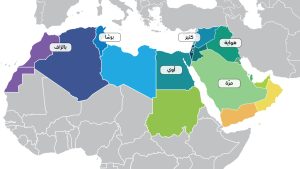
Arabic dialects can be broadly categorized into five primary groups:
- Levantine Dialects:
Spoken in Syria, Lebanon, Jordan, Palestine, and parts of Cyprus and Malta. - Gulf (Bedouin) Dialects:
Found in the Gulf states, Yemen, Iraq, parts of Egypt’s Sinai Peninsula, Mauritania, and the Arab desert tribes of Jordan, Syria, and Palestine. - Egyptian Dialects:
Dominant across Egypt and parts of Sudan and Palestine. - Maghrebi Dialects:
Native to Morocco, Algeria, Tunisia, Libya, and even parts of West Africa. - Sudanese Dialects:
Common in Sudan, South Sudan, and surrounding areas like Somalia and Ethiopia.
Modern Standard Arabic vs. Dialects
Most dialects differ in pronunciation and vocabulary, but all trace their roots back to MSA. That shared foundation means learners who begin with MSA find it easier to transition to dialects later. If you’re planning to visit an Arab country, it’s wise to learn essential Arabic travel phrases first—those basics will carry you far, no matter the region.

Do Dialects Hinder Arabic Learning?
Arabic dialects play a dual role in language learning. On one hand, they help learners engage with everyday life and local speakers. On the other, they can cause confusion if introduced before mastering the basics of MSA.
Vocabulary, grammar, and even phonetic structures can vary so much that switching dialects becomes a challenge—especially without a strong MSA foundation. Even within one dialect group (like Levantine Arabic), there are notable variations between cities like Damascus, Aleppo, and coastal or rural areas.
Still, one universal truth remains: nearly all Arabic speakers, regardless of region, understand MSA. It’s the language of the Quran, their shared history, and cultural heritage.
How to Handle Dialect Differences While Learning?
At Learn Arabic, we recommend starting with a solid foundation in MSA. It’s the common denominator of all dialects. Once you’re comfortable, gradually introduce one dialect—preferably based on where you live or plan to travel.
This approach reduces confusion and builds real-world fluency.
Case Study – Mohammad Khan from Pakistan
A user of Learn Arabic, Mohammad began with MSA before progressing to the Najdi dialect while living in Riyadh, Saudi Arabia. His solid MSA base helped him overcome dialect challenges. Later, when his job took him to Jeddah, he easily adapted to the Hijazi dialect thanks to his methodical learning path.
Learn Arabic App – Your Trusted Guide
Among various free resources for Arabic learners, the Learn Arabic app empowers users to master MSA first and then explore local dialects through simplified, practical lessons.
With self-paced modules and live classes, navigating the differences between Arabic dialects becomes easier and more intuitive.
Learning MSA is the key—dialects are the doors. With Learn Arabic, you’ll speak with confidence, no matter the dialect spoken around you.
If you’re just starting or looking to improve, our intelligent app is your perfect companion. Download it free for Android or iOS and explore the beauty of Arabic today.
Edited by: Learn Arabic Team
Sources: Wikipedia